
Yes, you can put solar panels on a flat roof in the UK — and in some cases it actually works better than a pitched roof. But flat-roof solar costs more to install, involves a structural check most pitched-roof owners never need, and is genuinely not worth doing if your roof membrane or joists are in poor shape. This guide gives you the honest version, so you can decide whether to go ahead before you spend a penny.
Do solar panels actually work on a flat roof?
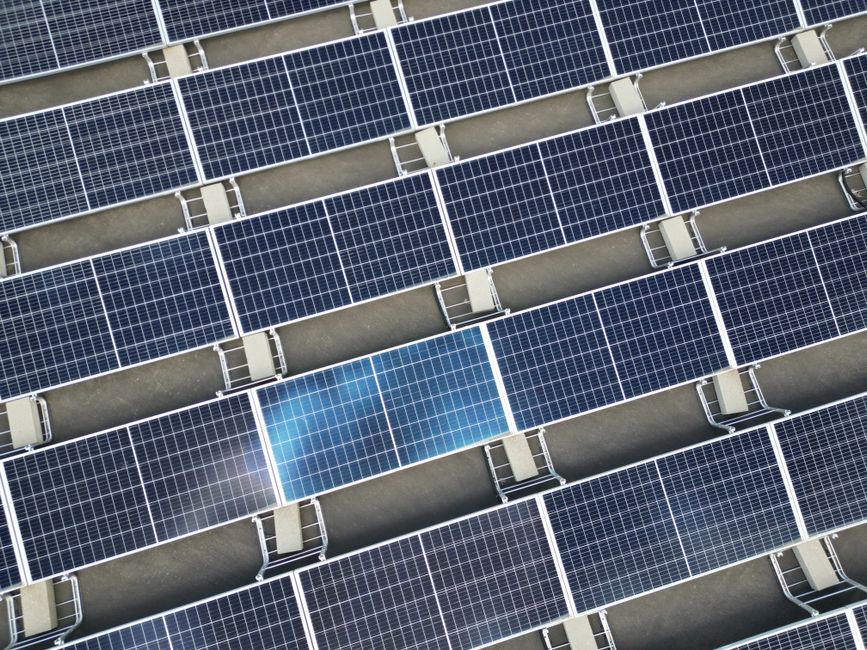
They do. The key is that panels can't just lie flat — a panel laid completely horizontal collects far less sunlight and pools water, which damages it faster. Every competent installer will mount them on angled frames set at around 10–15° (for a good balance of output, wind resistance and row spacing), or up to 30–35° if you want to maximise generation and have plenty of roof space.
The good news: because you're not locked into whatever angle your roof happens to sit at, you can choose your ideal orientation. If your house faces an awkward direction, a flat roof lets you point the panels whichever way works best — something a pitched-roof owner simply can't do.
An east-west split system — half the panels facing east, half west — is increasingly popular on flat roofs. It generates slightly less total electricity than a pure south-facing setup, but spreads generation more evenly across the day, which can mean you use more of what you produce without needing a battery.
How much extra does flat roof solar cost?
The mounting system is the main difference. On a pitched roof, panels follow the existing angle and the hardware is relatively simple. On a flat roof, you need either a ballasted frame (weighted with concrete blocks, no roof penetrations) or a mechanically fixed system bolted through the membrane — and those frames cost more.
Expect to pay roughly £500–£1,500 more than an equivalent pitched-roof install, depending on system size and which mounting type suits your roof. Labour can partially offset this: flat roofs are safer and easier to work on, so scaffolding costs are often lower — sometimes £500–£800 less than a pitched job.
For a typical 3–4kW system, total installed cost in 2026 runs to roughly £6,000–£9,000. That's the panels, inverter, mounting frames, labour and all associated hardware — with 0% VAT already applied (more on that below). For a larger system with a battery included, costs rise accordingly; one estimate for an average 3-bedroom home with battery puts the all-in figure at around £10,700.
These are typical ranges, not a quote for your home. The actual number depends on your roof type, system size, location and which installer you use — which is exactly why comparing at least three quotes matters. Our guide to Solar Quote Red Flags: Don't Get Ripped Off walks you through what to look for.
The structural check you must not skip
This is where flat-roof solar differs most from pitched-roof installations, and where cowboy installers cut corners. Ballasted mounting systems are heavy. A standard UK flat roof is typically designed for an imposed load of around 1.5 kN/m² — comfortably above the 30–45 kg/m² a ballasted solar array adds. But older garage roofs, lightweight extension roofs and timber-joisted dormer roofs can be considerably weaker.
You should commission a structural survey before committing if any of these apply to your roof:
- The roof was built before 2000 (older building codes used lower imposed loads)
- It was originally built as a garage or outbuilding roof
- Joists span more than 4 metres or are spaced more than 600mm apart
- It's a lightweight extension over a conservatory
A structural engineer's report typically costs £400–£900 in 2026. If strengthening is needed — extra joists or a stiffened deck — budget a further £800–£3,500. It's not cheap, but it's far cheaper than a roof failure or an insurer refusing a claim because the load wasn't checked. Any reputable installer will want confirmed load data before they quote; treat it as a red flag if they don't ask.
Also check your roof warranty before you let anyone drill into it. If you go with a bolted (penetrating) system, ask the installer who warrants the waterproof membrane after the job is done — and get the answer in writing.
Planning permission: what the rules actually say
Most flat-roof solar installs on standard homes fall under permitted development, meaning no planning application is needed. The key rule for flat roofs is that the highest point of the solar equipment must sit no more than 600mm above the highest part of the roof. Panels must also be set back from the roof edge.
There are exceptions. If your home is in a conservation area, national park, Area of Outstanding Natural Beauty or World Heritage Site, you'll need prior approval from your local authority before the work begins. Listed buildings are excluded from permitted development entirely. If in doubt, your installer should check with the local planning authority — another thing to confirm before you sign anything.
When does the maths actually work?
Solar on a flat roof can still make solid financial sense, provided the numbers stack up for your specific situation. Here are the factors that tip it one way or the other.
In your favour: The 0% VAT relief on residential solar installations (panels, inverter, battery and labour) runs until 31 March 2027, under HMRC VAT Notice 708/6. That's an immediate saving worth £1,000–£2,000 on a typical system — and it applies automatically; your installer just doesn't charge VAT. Once your system is running, the Smart Export Guarantee (SEG) pays you for surplus electricity you send back to the grid. In 2026, the best fixed SEG rates sit around 12–15p per kWh, according to the Ofgem SEG licensee register and supplier tariff pages. To qualify you need an MCS-certified installation and a SMETS2 smart meter. See our rundown of the Best Smart Export Guarantee Rates UK 2026 for the current figures.
Against you: Flat-roof mounting adds cost. If your roof needs structural work or membrane repair before panels go on, that extends your payback period. A roof in genuinely poor condition may make the project unviable until the roof itself is replaced — and if you're doing that anyway, it's worth timing both projects together to avoid dismantling the panels a few years later.
A worked example (clearly labelled — your home will differ): A typical 3-bedroom home with a 4kW south-facing flat-roof system, no structural issues, might see electricity bill savings of roughly £600–£900 a year at current grid prices, plus SEG export income on top. At a total installed cost of around £7,500–£8,500, that suggests a payback period somewhere in the region of 8–12 years — with panels that typically come with a 25-year performance warranty. That's a reasonable return, but it's not guaranteed. Your actual savings depend on your household's energy use, how much you shift to daytime, whether you add a battery, and your local solar irradiance. For a deeper look at payback across different home types, see our guide to Solar Panel Payback Time UK 2026: The Honest Truth.
When flat-roof solar probably isn't worth it
Being straight about this is part of giving useful advice. Flat-roof solar is likely a poor use of money if:
- Your roof membrane is near end of life and needs replacing — fit solar after, not before
- The structural check reveals significant strengthening work is needed, pushing total costs beyond what the savings can recover in a reasonable timeframe
- Heavy, persistent shading (trees, neighbouring buildings, plant equipment) covers the roof for most of the day
- The roof area is too small to fit a meaningful system once frames, edge setbacks and inter-row spacing are accounted for
- You're planning to sell within three or four years and the market premium for solar in your area doesn't cover the outlay
None of this means flat roofs are bad for solar in general — it means the details matter more than they do on a simple south-facing pitched roof. A proper site survey sorts the genuine candidates from the marginal ones.
What to ask before you get quotes
A few questions worth putting to any installer before you commit:
- Will you provide a full structural load calculation for my roof, or recommend a structural engineer if needed?
- Are you using a ballasted or mechanically fixed system, and why is that right for my roof type and wind zone?
- Who warrants the roof membrane after installation — you, a roofing subcontractor, or neither?
- What tilt angle and row spacing are you designing to, and can you show me the shading analysis?
- Do you carry MCS certification? (Required for SEG eligibility and consumer protections.)
If an installer brushes past these questions or gives vague answers, that tells you what you need to know. FairSolar only connects homeowners with vetted, MCS-certified installers — and you can see how the service works and how FairSolar is paid at our transparency page.
If you're ready to find out what flat-roof solar would actually cost for your home, get free, no-obligation quotes from vetted local installers. Answer a few questions, get real numbers, no pressure.
Frequently asked questions
Can you put solar panels on a flat roof in the UK?
Yes — thousands of flat-roof solar installations are completed in the UK every year, on both homes and commercial buildings. Panels are mounted on angled frames (typically 10–35°) rather than laid flat, which maintains output and prevents water pooling. The main extra requirements are the right mounting system and, in some cases, a structural check.
How much extra does a flat roof solar installation cost compared to a pitched roof?
The mounting frames typically add around £500–£1,500 to the total cost, mainly for the ballasted or fixed frame system. Labour can be slightly cheaper on flat roofs because access is safer, which partially offsets this. A typical 3–4kW flat-roof system in 2026 costs roughly £6,000–£9,000 fully installed, including 0% VAT.
Do I need planning permission for solar panels on a flat roof?
In most cases, no. Under permitted development rules, flat-roof solar panels don't need planning permission as long as the equipment sits no more than 600mm above the highest part of the roof and is set back from the edge. Exceptions apply if your home is in a conservation area, national park or AONB, or if it's a listed building — in those cases you'll need prior approval from your local authority.
Do I need a structural survey before installing solar on a flat roof?
Not always, but often. Standard UK flat roofs can handle the load of a ballasted solar system, but older garage roofs, lightweight extension roofs and timber-joisted dormer roofs may not. If your roof was built before 2000, was designed as a garage or outbuilding, or has widely-spaced joists, commission a structural engineer's report first. Expect to pay £400–£900 for a survey; strengthening work, if needed, costs more on top. A reputable installer will raise this with you — if they don't, that's a red flag.
Will flat-roof solar panels generate as much electricity as panels on a pitched roof?
When correctly mounted at around 10–15° and south-facing, flat-roof panels can generate around 90–95% of the output of an equivalent south-facing pitched roof. The bigger risk to output is self-shading between rows if the installer hasn't left adequate spacing — which is why the system design (not just the panels) matters. An east-west split layout, where half the panels face east and half face west, is another good option that spreads generation more evenly through the day.